
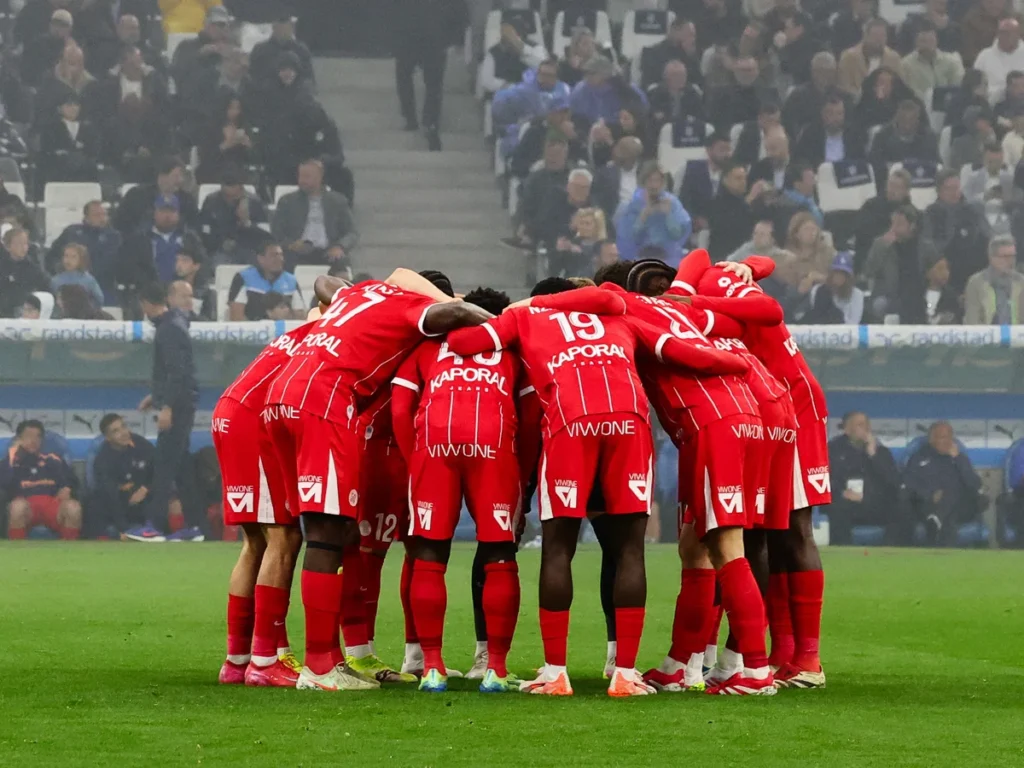
Direct football remains a significant tactical choice in Ligue 1, not as a fallback but as a deliberate response to league-specific constraints. While possession-oriented models dominate discussion, several teams structure their entire game around vertical progression, early balls forward, and rapid territorial gain. Understanding which teams rely on direct play requires examining not just pass length, but how squads are built to exploit space, manage risk, and shorten attacking sequences under pressure.
Why direct football remains viable in Ligue 1
The persistence of direct play in Ligue 1 is closely linked to athletic mismatches and transitional volatility. Many teams face opponents with superior technical depth, making prolonged buildup structurally risky. Direct football reduces exposure by limiting touches in deep zones and shifting contests into aerial duels and second-ball battles. This approach prioritizes territory over control, trading possession share for situational advantage. In a league where defensive errors often occur under physical stress rather than positional overload, this logic remains sound.
Structural characteristics of direct-play teams
Teams built around direct football share identifiable structural traits that shape every phase of play. Defensive lines often sit slightly deeper to invite pressure, while midfielders position themselves to contest knockdowns rather than orchestrate circulation. Forwards are selected for physical presence and channel running, not link-up volume. Fullbacks advance selectively, supporting long balls rather than overlapping consistently. These structural choices compress the game vertically and accelerate outcomes, reducing the number of decisions required per possession.
Matchups where direct play becomes the primary solution
Direct football is most prominent in fixtures where technical inferiority is clear or where pressing resistance is limited. Against high-pressing opponents, bypassing midfield zones minimizes turnover risk. Similarly, away matches against possession-heavy sides often push teams toward direct solutions to escape sustained pressure. The outcome is not necessarily chaotic; instead, games settle into predictable rhythms defined by aerial contests, recoveries, and rapid restarts that favor prepared structures.
Teams most associated with direct football tendencies
Across recent seasons, teams like FC Metz and Stade Brestois have frequently leaned toward direct play as a base identity. Their approach is not purely reactive; it is embedded in recruitment and training priorities. Strikers are tasked with occupying center-backs, while wide players attack second phases aggressively. The result is consistent verticality regardless of match context, producing stable patterns even when trailing or leading.
Direct play and statistical interpretation pitfalls
From a data-driven perspective, direct teams often appear inefficient in conventional metrics. Low pass completion, reduced possession, and limited progressive carries can obscure their effectiveness. However, these statistics ignore the intentional compression of attacking sequences. When a team aims to reach the final third within two or three actions, failure rates naturally rise, but successful outcomes carry disproportionate value. Interpreting direct play therefore requires aligning metrics with intent rather than stylistic norms.
Before examining situational outcomes, it is useful to outline how direct play typically manifests across match phases. Analysts often track entry methods, duel locations, and clearance directions to identify consistent patterns. The table below summarizes common indicators associated with direct-oriented Ligue 1 teams and their functional purpose within matches.
| Tactical Indicator | On-Field Behavior | Strategic Impact |
| High long-pass ratio | Frequent early balls forward | Reduces buildup risk |
| Aerial duel concentration | Contests near halfway line | Shifts pressure upward |
| Narrow midfield spacing | Players close to second balls | Increases recovery rate |
| Limited lateral circulation | Few horizontal passes | Accelerates transitions |
Interpreting this table highlights how direct play prioritizes control of zones rather than possession volume. Each indicator supports the same outcome: faster resolution of phases and reduced exposure in vulnerable areas. When multiple indicators align, teams tend to stabilize performance even against stronger opponents, though margins remain thin.
Market perception of direct-play matches
When direct football dominates a fixture, match narratives often diverge from market expectations. Low possession teams may appear passive despite creating equal or greater territorial pressure. In analytical review, this discrepancy becomes relevant during odds comparison or live evaluation. Under certain situational conditions, observers navigating a betting environment may encounter ยูฟ่าเบท168 วีไอพี while assessing how direct-play dynamics influence totals or match flow. The critical insight is that vertical styles can compress variance, making outcomes less sensitive to possession swings and more dependent on isolated duels.
Where direct football tends to break down
Despite its efficiency, direct play carries structural limits. When opponents dominate aerially or win second balls consistently, vertical progression stalls. Additionally, chasing games through direct methods can become predictable, allowing defenders to set traps and clear centrally rather than wide. Ligue 1 teams lacking depth often struggle when forced to deviate from this model, as their squad profiles are optimized for one tempo rather than adaptability.
Conditional scenarios that reduce effectiveness
Direct football loses efficiency when weather conditions slow ball speed or when refereeing allows minimal contact in aerial contests. In these contexts, the intended physical advantage diminishes, exposing technical gaps.
Summary
Ligue 1 teams that rely primarily on direct football do so as a calculated response to competitive imbalance, physical demands, and transitional risk. Their structures favor territory, speed, and simplified decision-making over sustained control. While conventional metrics may undervalue this approach, its effectiveness depends on coherence between squad profile and tactical intent. Direct play succeeds when conditions align and fails when opponents neutralize its core mechanisms, underscoring its role as a precise tool rather than a universal solution.